An AI agent that improves another agent in 17 hours: GPT-5.6-Sol takes Kimi K3 from 77.5% to 88.8% on Terminal-Bench 2.1
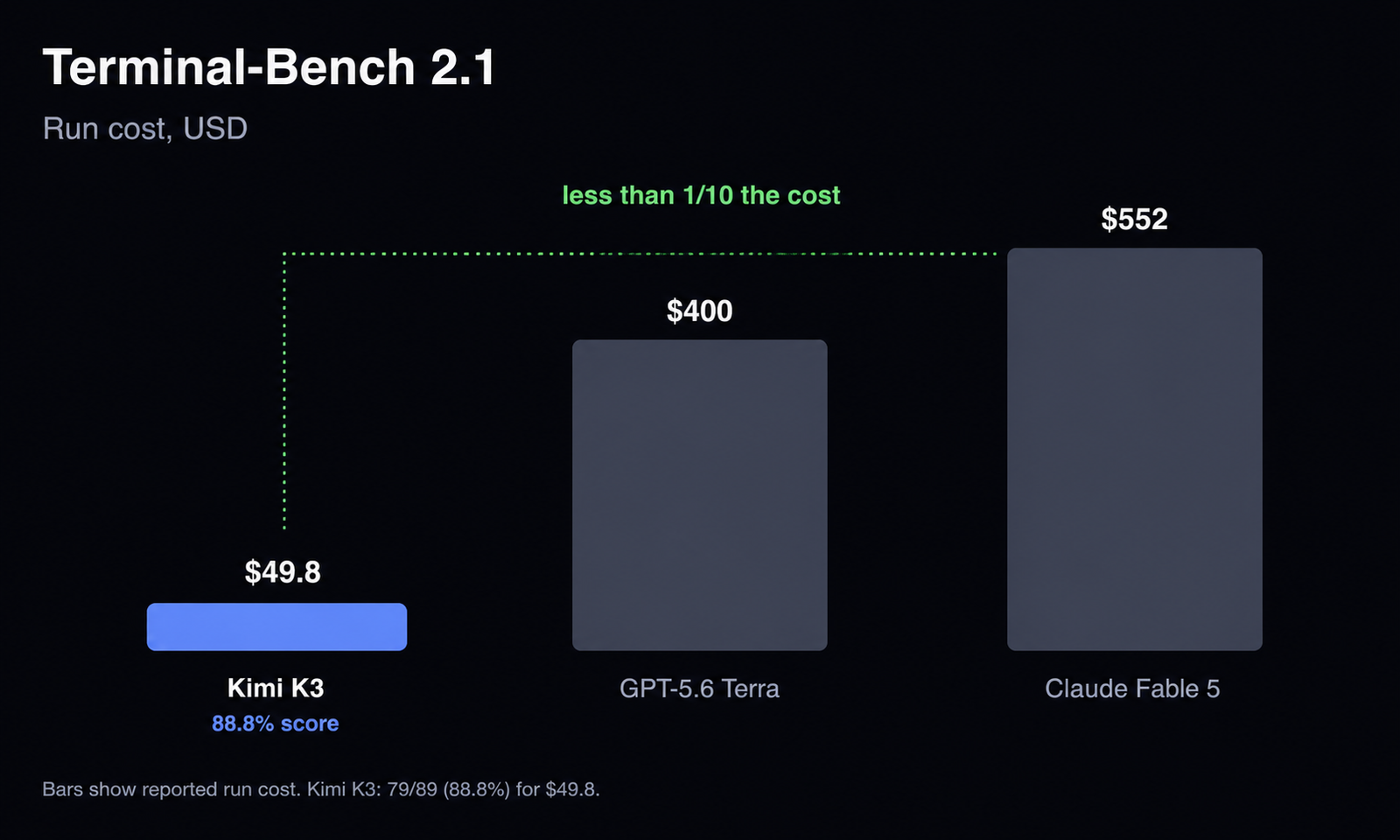
Cline let GPT-5.6-Sol work on its harness for 17 hours: Kimi K3 went from 77.5% to 88.8% on Terminal-Bench 2.1, cost per run down from $79 to $49.8 (−37%).

Luca Di Domenico
· 2 min read
In short
The Cline team gave GPT-5.6-Sol a single prompt and let it work on the Cline harness for about 17 hours. On Terminal-Bench 2.1, Kimi K3’s score went from 77.5% (69/89 tasks) to 88.8% (79/89 tasks), with cost per run dropping from $79 to $49.8 (−37%) and zero benchmark-specific fixes. The agent found and fixed real harness problems on its own — smart retries on rate limits, a smarter loop detector, prevention of process “suicides” — with almost zero human intervention: one initial prompt and an occasional “continue”.
🚀 An AI agent that improves another agent in 17 hours
The Cline team’s experiment: a single prompt for 17 hours
Imagine giving a coding agent a single prompt and letting it work for 17 hours straight.
That’s exactly what the Cline team did.
They asked GPT-5.6-Sol to improve Cline’s harness so that Kimi K3 would perform better on the Terminal-Bench 2.1 benchmark (one of the hardest and most realistic tests for agents that use the terminal, with 89 real tasks).
The experiment is documented in the post Recursive Self Improvement for Coding Agents on the Cline blog (July 24, 2026); Terminal-Bench is a Stanford x Anthropic benchmark with 89 real tasks (official site).
The results on Terminal-Bench 2.1
Results after 17 hours of autonomous work:
• Kimi K3’s score: from 77.5% (69/89 tasks) → 88.8% (79/89 tasks)
• Cost per run: from $79 → $49.8 (−37%)
• Zero benchmark-specific fixes (no tricks)
The Cline team says GPT-5.6-Sol autonomously improved both the quality of the coding agent and its token consumption 🤯
The numbers — 69/89 → 79/89 tasks and cost per run from $79 to $49.8 — are reported in Cline’s announcement on X and in the technical post on their blog (July 2026).
The harness problems fixed autonomously
GPT-5.6-Sol found and fixed real harness problems on its own:
• smart retries on rate limits
• a smarter loop detector (that no longer killed legitimate processes)
• prevention of process “suicides”
Almost zero human intervention. Just an initial prompt and an occasional “continue” every now and then.
What this experiment proves
This proves two important things:
1) Frontier models are already capable of automatic improvement on complex systems.
2) The real bottleneck is no longer the model, but the harness and how we use it.
The era of agents optimizing other agents
Cline is open source, so anyone can replicate the same process.
We have entered the era where one AI agent optimizes another AI agent.
What do you think?
Sources
- Recursive Self Improvement for Coding Agents — Cline blog, July 24, 2026: ~17-hour campaign from a single prompt with GPT-5.6-Sol as leader model; Kimi K3 from 69/89 (77.5%) to 79/89 (88.8%) on Terminal-Bench 2.1, cost per run from $79 to $49.8, with general harness fixes only
- Cline on X: campaign results announcement — Cline, July 2026: from 77.5% to 88.8% on Terminal Bench after 17 hours of autonomous work, cost per run from $79 to $49.8
- Terminal-Bench — official site — Stanford x Anthropic benchmark for agents that use the terminal: Terminal-Bench 2.0 counts 89 real tasks across software engineering, ML, security and data science; 2.1 is its improved version
Want to know what this means for your product?
If you're building software with AI and want a second opinion on how you're working, tell me about your project.
 Tell me about your project